Information is hard to manage.
We live more and more of our lives online and in digital spaces. The information we generate about ourselves and our activities in those spaces is always shared with a host of people, agencies, and corporations. Some of these organzations just want to make a buck in advertising fees at our expense, others want to use that information to do us harm. PUBLIC EYES is a graphic narrative that tells the story of one situation in which information cannot be controlled despite having the best in the business at the helm.
The Story.
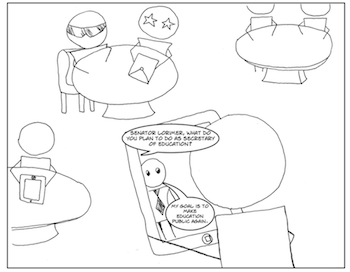
Virus–known simply as VI–is a reputation manager hired to scrub the available background information of the nominee for Secretary of Education. VI is slowly thwarted as it becomes incredibly difficult to manage the swirling of information in the lead up to nominee’s senate hearing.
The Stick Figure Consortium is a cross-instutitonal collaboration between students at the University of Utah (Englis 5950/Writing 5905) and the University of Wisconsin-Madison (English 236). The courses were taught by Casey Boyle and Jim Brown in Spring 2014. Public Eyes was creating during a six-week period, and it was authored and drawn entirely by students. The Consortium used Comic Life software for layout and lettering.
After intensively studying network theory and culture, students of English 5950–held at the University of Utah–wrote the script for the graphic novel “Public Eyes.” Influenced by Panel Syndicate's The Private Eye, we look to the concept of the ever-present cloud bursting as inspiration for our story. The "cloud burst" is what it is like to experience steady leaking of social media information into unwanted areas and discussions. With the rise of social media platforms the question has become how much is too much? What happens when, against our desires, our online interactions overflow into other situations? The writing of the Public Eyes script allowed the class to explore multiple aspects of Network Theory. The story is a meditation on network culture, drawing on the work of theorists such as Michel Foucault and Steven Shaviro and addressing the impact of technologies like Twitter.
Design, layout, and artwork of Public Eyes was done by the English 236 class from the University of Wisconsin–Madison. The class brought to life the ideas from the University of Utah students, transitioning them into an electronic comic-book form using the program ComicLife. Students in English 236 (“Writing and the Electronic Literary”) used emerging digital media to analyze and create literary objects. From comics to video games to interactive fiction and hypertext, the class explored how computational and networked environments shift our notions of reading and writing.
PUBLIC EYES is published under an Attribution-NonCommercial-ShareAlike Creative Commons License.

We are requesting that anyone downloading PUBLIC EYES please consider donating to The Comic Book Project, a charity that helps schools and after school programs give children an opportunity to create their own comics.